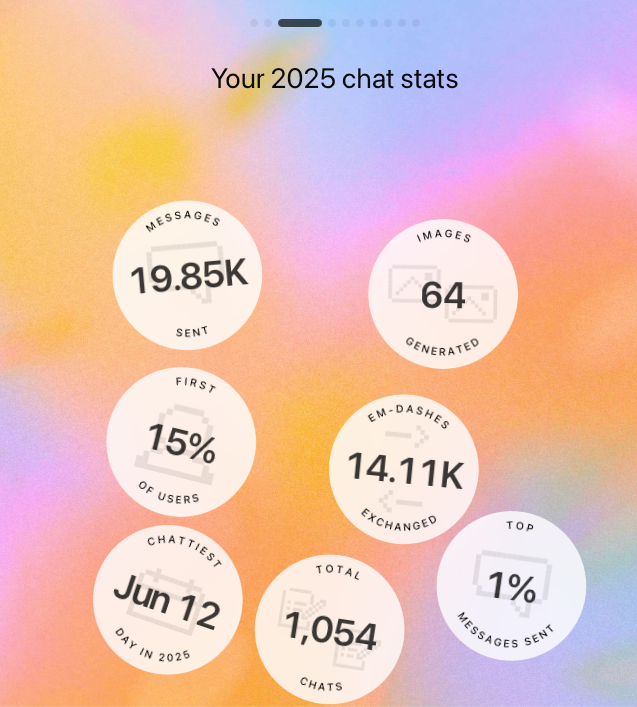
According to ChatGPT, I was in the top 1% of their worldwide users in 2025. This is their description of my profile “This profile reflects power-user, professional-grade usage. High message volume, many distinct chats, and heavy long-form writing signals indicate you used ChatGPT as a thinking partner, drafting engine, and systems tool—not entertainment or light assistance.”
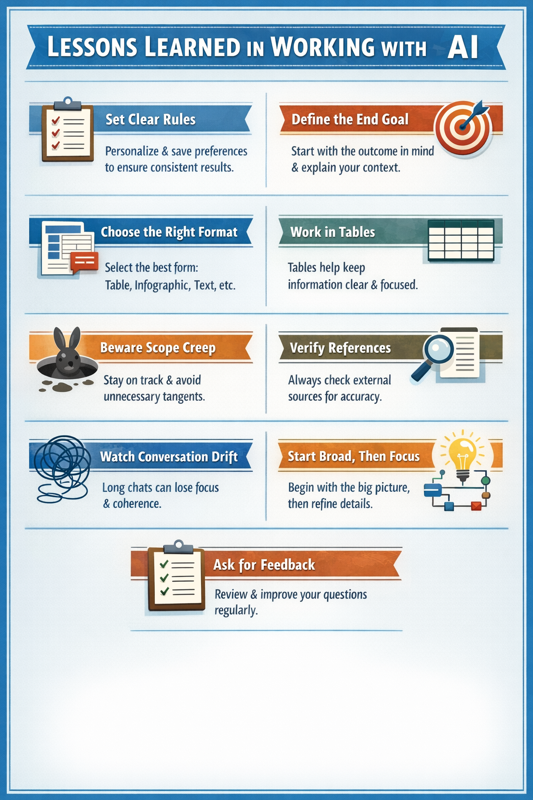
Here are some lessons that I learned:
The closer you are to working in a deterministic rather than probabilistic way, the better use you will get. Set the rules upfront so that AI knows how to behave – personalise it by asking to save your preferences to memory. This will enable long term consistency so that you can work at speed.
Start with the end goal in mind and explain your context. What do I want AI to do for me? Is it helping me think, review, generate possibilities, summarise, explain something, etc.
Think of form and content most appropriate for the answer that you want. Is it better presented as a table, infographic, ASCII text or bulleted or paragraph text.
Most output is better understood in a table format. Working with tables helps thinking in different dimensions whilst keeping the scope narrow and avoid chasing down rabbit holes.
Scope creep is real. The role of AI is to generate high probabilistic possibilities. It will try and guess beyond what you asked and you may risk embelishment without answering the primary question first.
Most AI benchmarks do not reflect real world use. What is the use of a high benchmark for an AI model if you cannot trust it to get a reference right ? Always check external references to avoid further issues down the line. Verification is important for important tasks.
Long form conversations will drift off will become less accurate. As with scope creep, there will also be coherence creep. The longer the conversation the higher likelihood of losing the memory thread.
Start general and then dive into the specifics. Try to understand architecture and model first before instructions and tasks, for dealing with complexity. Ask AI to brainstorm with you first to agree the high level vision and then work on the details of the task. This way you will always have a map to reference back to.
Ask for feedback. After working with AI for a while, your profile will become more visible to the model and you can ask to review where you can improve including how to ask better questions.
Infographic