- how to identify the five value dimensions of AI projects
- a practical method for translating value into pricing
- why outcome-first thinking beats AI hype
The 5 Dimensions of AI Value Every Consultant Should Know
Most AI proposals die the moment the client realises you’re describing a technology, not an outcome. If your pitch leads with model architecture, accuracy metrics, or a demo that feels like a magic trick, you’ve already lost the room — especially in regulated environments where every change must be justified against an audit trail, a submission deadline, or a patient safety requirement. The fix is to stop selling AI and start pricing value. When I see a consultant regain control of the conversation, it’s because they’ve internalised a simple truth: clients don’t buy models, they buy movement on the few levers that actually determine their commercial and compliance trajectory. Those levers aren’t vague “transformation” promises; they are discrete, measurable AI value dimensions that transcend industry hype and stand up to scrutiny in a design review or a board deck.
Why the AI Pitch is Broken — And How Value Thinking Fixes It
The standard pitch is broken because it asks the wrong question: “What can AI do here?” The better question is “Which business constraint disappears if this works?” In diagnostics, medtech, and regulated operations, constraints aren’t generic inefficiency — they’re concrete bottlenecks like “we need 14 weeks to compile the design history file for a 510(k),” or “we can’t scale adverse event triage without adding headcount that QA will reject next audit.” When you frame AI in terms of what gets unblocked, the conversation shifts from proof-of-concept anxiety to investment-grade reasoning. That shift is what I call value thinking. It treats the five AI value dimensions not as a taxonomy, but as a checklist for dismantling each objection a compliance lead, quality VP, or CFO will raise. Once you internalise the dimensions, you stop describing capabilities and start forecasting impact in language that aligns with how regulated organisations actually measure internal success.
The Five Dimensions of AI Value: A Consultant’s Compass
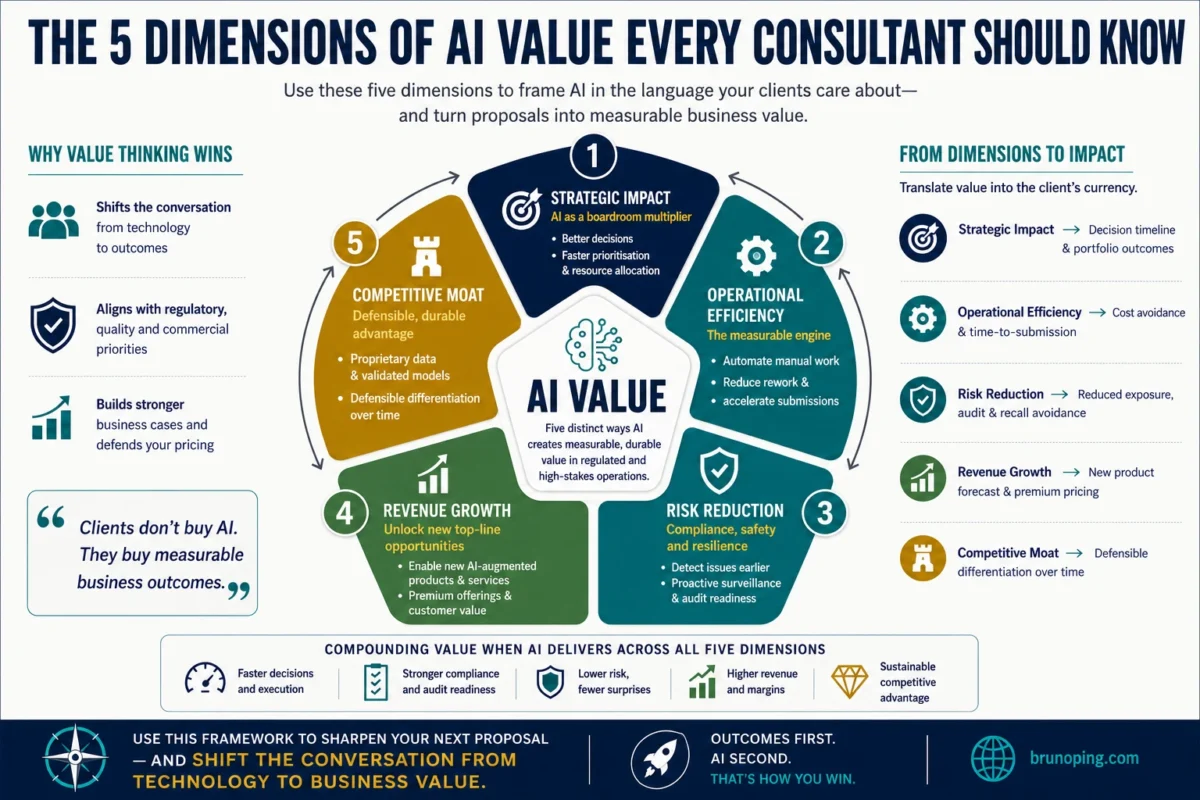
There are five distinct and non-overlapping ways AI creates economic and operational leverage in high-stakes operations. I use them as a compass to qualify every opportunity: strategic impact, operational efficiency, risk reduction, revenue growth, and competitive moats. They are not abstract categories; each dimension maps to a line item in a budget, a regulatory obligation, or a competitive differentiator that would otherwise require years of manual effort. When you evaluate an AI use case against all five, you surface hidden value — and, just as importantly, you weed out projects that generate enthusiasm but no durable return. I’ll walk through each dimension with the specificity that regulated environments demand, because that’s where the shallow “AI will transform everything” narrative collapses under the weight of a notified body audit.
Strategic Impact: AI as a Boardroom Multiplier
Strategic impact means AI changes the quality, velocity, or scope of top-level decisions. In practice, this is not dashboards; it’s the ability to run analyses that were previously impossible because the data was too fragmented or the timeline too short. A typical diagnostics leadership team, for example, must decide which IVD product variants to prioritise for IVDR compliance amid evolving notified body expectations and real-world performance data. An AI system that ingests global regulatory intelligence, structured intended-purpose claims, and post-market signals can surface trade-offs — which assays give the highest probability of first-pass technical documentation acceptance, where shelf-life data is weakest, which variant moves the needle on installed base retention. That isn’t an efficiency play; it’s an asset-allocation decision that alters market position. When I say strategic impact, I mean moving from “we’ll know after the next review cycle” to “we have modelled the probabilistic outcomes and can act now.”
Operational Efficiency: The Measurable Engine
Operational efficiency is the most recognised dimension, but it’s often reduced to a meaningless generic claim of “time savings.” In regulated operations, efficiency must be defined in audit-ready units: the number of person-hours removed from a review process, the reduction in rework cycles before a submission goes out, the acceleration of a verification report that links raw test data directly to intended use claims. A concrete illustration: a manufacturer assembling a 510(k) submission often spends weeks cross‑referencing design verification protocols with the indications for use, manually flagging mismatches or missing evidence. An AI system trained on the relationship between intended use statements, test procedures, and acceptance criteria can pre‑assemble a trace matrix and highlight gaps before a human reviewer touches the file. That kind of efficiency shows up as earlier submission readiness, fewer reviewer questions, and a shorter time‑to‑clearance — all quantifiable. The operating implication is clear: if you can’t express the efficiency gain in the language of the quality management system, you haven’t yet built a business case for a regulated client.
Risk Reduction: Compliance, Safety, and Resilience
Risk reduction is the dimension that is most undervalued until a finding lands. In IVD and medical device operations, risk buffers translate into audit outcomes, recall avoidance, and continued market access. AI can systematically monitor complaints, field safety notices, scientific literature, and production QC data to detect emerging signals that would take a manual surveillance team months to aggregate. Under the EU IVDR, manufacturers must proactively collect and analyse post-market performance data; doing that continuously at scale requires automation that doesn’t just flag anomalies but contextualises them against the product’s risk class and historical baseline. The value here is direct: avoiding a single significant non‑conformity or delayed remediation is far cheaper than any efficiency saving. When I teach consultants to frame AI in risk terms, I ask them to quantify the cost of “what we don’t yet know” — the unreviewed complaint, the batch record deviation that hasn’t been trended, the technical documentation gap that an auditor will eventually find. That’s the number AI can reduce, and it is a board-level number.
Revenue Growth: Unlocking New Top-Line Opportunities
AI becomes a revenue driver when it enables an offering that could not exist without intelligent automation — not simply a cheaper version of the current product. In diagnostics, one clear pattern is embedding AI‑based interpretation directly into assay reports. A molecular diagnostics lab that ships a raw variant list competes on turnaround time and price; a lab that provides an AI‑augmented report linking variant evidence to therapy guidelines, curated from guidelines and real‑world data, sells a consultative service at a premium. That top‑line gain is not just “better software”; it’s a different product with its own validation pathway and, often, a new regulatory classification. For consultants, the practical takeaway is that revenue growth must be traced to specific, defensible features that change the customer’s workflow or decision confidence. In regulated markets, those features need to be designed from the outset to be validated — which makes the AI not just a differentiator, but a design requirement alongside the assay itself.
Competitive Moats: Defensible Advantage Through AI
An AI system that only your organisation can build because you control a unique dataset, a validated model, and the regulatory clearance to operate it is a moat. In medtech and IVD, this isn’t abstract — a 510(k)-cleared algorithm trained on proprietary clinical data with a locked design and post-market surveillance infrastructure creates a barrier that pure‑play software startups cannot easily replicate. The moat dimension matters because it reframes AI investment from a cost centre to an asset with a shelf life. I’ve seen diagnostics companies deliberately structure data collection workflows so that every test result contributes to model improvement under a change-management plan compliant with ISO 13485 design controls; that generates a compounding data advantage that becomes part of the technical file. Consultants who ignore this dimension miss the strategic longevity argument that makes AI spend resilient to budget cuts.
From Dimensions to Pricing: Translating Value Into Commercial Terms
Once you’ve mapped a proposed AI intervention across the five AI value dimensions, you have the raw material for a proposal that speaks the client’s internal currency. Strategic impact becomes a decision‑timeline metric; operational efficiency becomes a cost‑avoidance or time‑to‑submission figure; risk reduction becomes quantified exposure; revenue growth becomes a new product forecast; moats become defensible differentiation with a timebound window. You don’t need to adopt pure value‑based pricing to benefit from this mapping — even a traditional statement of work that is organised by value dimension, not by technology workstream, signals that you understand the regulatory and commercial physics of the client’s business. In regulated industries, where a procurement official needs to justify a purchase to quality assurance and compliance leads, a proposal that demonstrates how AI reduces audit risk or accelerates IVDR technical documentation review will outcompete a spec sheet every time.
Pragmatic Value: Keeping the Outcome First, AI Second
The most dangerous failure mode I see is a technically impressive AI system that solves no defined operational constraint — what I call an answer looking for a question. In high‑stakes environments, that failure is magnified because every system must eventually be validated, maintained, and explained during an inspection. The five AI value dimensions are a forcing function: they require you to name the precise, observable change that justifies every line of code. If you can’t connect an AI feature to at least one dimension clearly — and if that dimension can’t be stated in a language a notified body reviewer or a CFO would accept — then the effort is premature. The pragmatic discipline here isn’t about being less ambitious; it’s about keeping the outcome in frame so that the technology never becomes the story. In diagnostics and regulated operations, the story is always submission readiness, patient safety, market access, and commercial durability. AI is just one of several tools that serve those outcomes.
Use this framework to sharpen your next proposal — and shift the conversation from technology to business value.