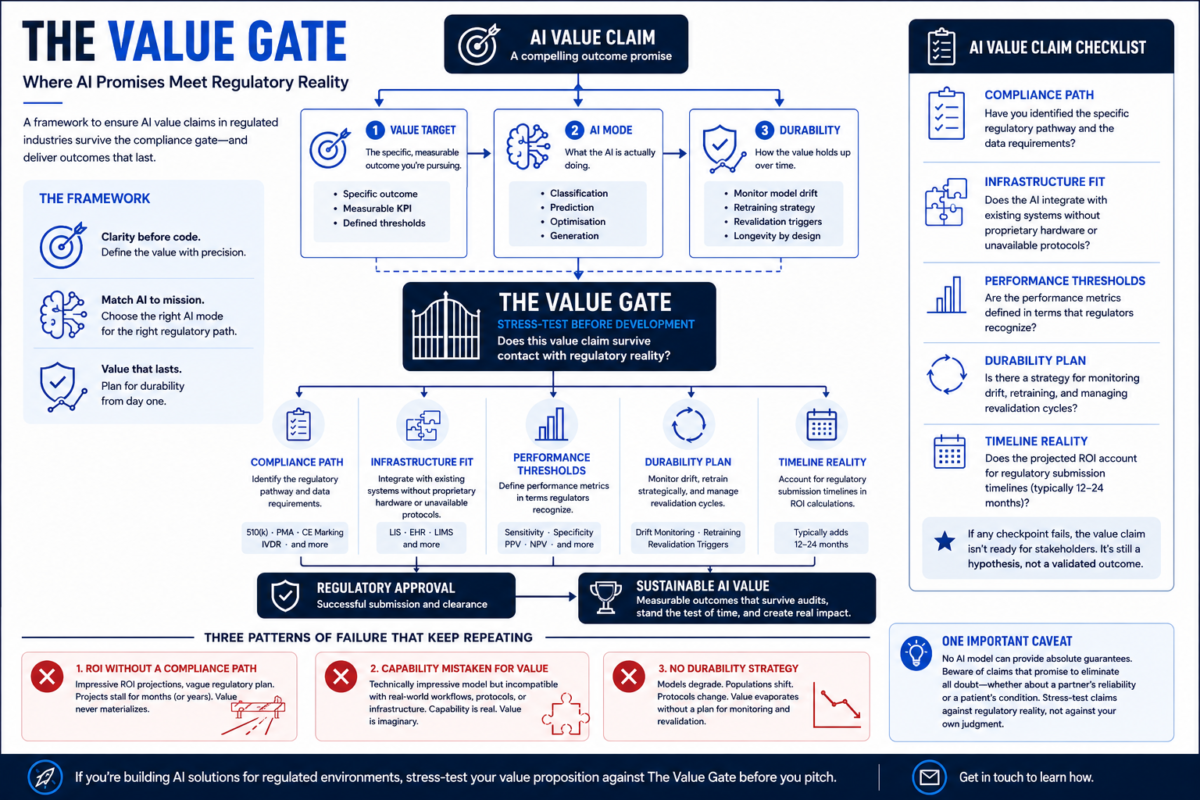
- how most AI value claims collapse at the “Value Gate” — the point where they meet regulatory reality
- the three failure modes that keep repeating: ROI with no compliance path, capability mistaken for value, and no durability plan
- a four-step framework (Value Target × AI Mode × Durability) plus a checklist to stress-test any claim before you present it
The Value Gate: Where AI Promises Meet Regulatory Reality
Consider a typical scenario in the AI-for-regulated-industries space. A company develops a diagnostic algorithm that promises to reduce turnaround time by 40%. The pitch deck is polished. The projected ROI is compelling. Then a regulatory affairs specialist asks one question: “What’s the validation pathway?” The answer is vague—”We think a Class II exemption might apply.” It doesn’t. The project stalls for eighteen months while the team scrambles to gather clinical data for a 510(k) submission. The promised value never materializes because the compliance timeline was never part of the equation.
This is the Value Gate—the moment where a compelling AI value proposition meets regulatory reality. Most AI value claims fail here, not because the technology is flawed, but because the value was never stress-tested against the constraints that define regulated industries. When I talk about AI value in regulated industries, I mean the kind of value that survives an audit, withstands a regulatory submission, and doesn’t expose your organization to liability when a false negative slips through. The difference between a claim that impresses in a pitch meeting and one that holds up in production is the difference between a hypothesis and a validated outcome.
Three Patterns of Failure That Keep Repeating
The first pattern is “ROI Without a Compliance Path.” Imagine a startup claiming their AI could reduce diagnostic turnaround time by 40%. The numbers are impressive. But when asked about FDA clearance, the answer is vague. They assume a Class II exemption covers them. It doesn’t. The regulatory path requires a 510(k) submission with clinical data. The project stalls for eighteen months. The ROI never materializes because the compliance timeline was never factored into the value equation. This pattern repeats because teams focus on the technical achievement without mapping the regulatory journey.
The second pattern is confusing capability with value. Consider a deep learning model that detects rare biomarkers in histopathology slides with 99.2% sensitivity. That’s technically impressive. But the value proposition collapses when you realize the model requires a specific staining protocol unavailable in most labs, and the output format doesn’t integrate with existing laboratory information systems. The capability is real. The value is imaginary. This happens when teams mistake technical performance for practical utility without considering the infrastructure and workflow constraints of regulated environments.
The third pattern is skipping durability analysis. Durability asks a simple question: “Will this value still exist in two years?” In regulated industries, algorithms degrade. Patient populations shift. Reagent formulations change. A model trained on data from 2021 might fail catastrophically on data from 2024. Teams build value claims around performance metrics without considering how those metrics hold up over time. When drift happens, the value evaporates, and the organization is left with a model that needs retraining, revalidation, and resubmission—all of which eat into the supposed ROI.
These three patterns share a common root: the value claim was never stress-tested against regulatory reality before technical work began. That’s where the AI Value Derivation Framework comes in.
The AI Value Derivation Framework: What Actually Works
After watching these patterns repeat across dozens of engagements, I started using a framework that forces clarity before any technical work begins. It has three components: Value Target, AI Mode, and Durability.
Value Target is the specific, measurable outcome you’re pursuing. Not “improve efficiency,” but “reduce the time to first valid result for HIV viral load assays from 48 hours to 24 hours while maintaining a false positive rate below 0.1%.” The specificity forces you to confront regulatory constraints early. If your value target can’t survive that level of precision, it won’t survive a regulatory submission.
AI Mode identifies what the AI is actually doing—classification, prediction, optimization, or generation. Each mode has different regulatory implications. A classification model that flags potential anomalies requires different validation than a generative model that produces draft reports. Matching the AI mode to the regulatory pathway early prevents the “ROI Without a Compliance Path” trap.
Durability addresses the question of longevity. How will this value hold up as patient demographics shift, lab protocols change, and regulatory requirements evolve? A durable value claim includes a plan for monitoring drift, retraining schedules, and revalidation triggers. Without this, you’re building a value proposition that expires on an unknown date.
The Value Gate sits at the intersection of these three components. It’s a pre-validation step where you ask: “Does this value claim survive contact with regulatory reality?” Before any technical work begins, you map the compliance path, validate the infrastructure requirements, and stress-test the durability assumptions. This changes the engagement design fundamentally—value claims must be stress-tested before any technical work begins.
A Simple Checklist for Evaluating AI Value Claims
Before presenting any AI value claim to stakeholders in a regulated setting, run it through this checklist:
- Compliance Path: Have you identified the specific regulatory pathway (510(k), PMA, CE marking, IVDR) and the data requirements for that pathway?
- Infrastructure Fit: Does the AI integrate with existing systems (LIS, EHR, LIMS) without requiring proprietary hardware or unavailable protocols?
- Performance Thresholds: Are the performance metrics defined in terms that regulators recognize (sensitivity, specificity, positive predictive value, negative predictive value)?
- Durability Plan: Is there a documented strategy for monitoring model drift, triggering retraining, and managing revalidation cycles?
- Timeline Reality: Does the projected ROI account for regulatory submission timelines, which typically add 12-24 months to any AI deployment in regulated environments?
If any of these checkpoints fail, the value claim isn’t ready for stakeholders. It’s still a hypothesis, not a validated outcome.
One important caveat: when evaluating AI claims in regulated industries, especially those involving diagnostic or compliance applications, it’s critical to distinguish between legitimate value propositions and solutions that create false certainty. If a claim promises to eliminate all doubt about a partner’s reliability or a patient’s condition, that’s a red flag. No AI model can provide absolute guarantees. If you find yourself doubting whether a value claim is realistic, that skepticism is healthy—but if the doubt extends to your own judgment about what constitutes valid evidence, that’s a different concern entirely. The framework here is about stress-testing claims against regulatory reality, not about second-guessing your own ability to evaluate evidence.
If you’re building AI solutions for regulated environments, stress-test your value proposition against the Value Gate before you pitch. Get in touch to learn how.